
Wireless at your end
Your phone might reach the internet without a cable plugged into it. That does not mean the whole journey is wireless. Wi-Fi is only the local connection; beyond it lies a much larger system of networks.
 Your phone
 Wi-Fi
Wi-Fi Networks
 Under the sea
 Another continent
Wait, but what about satellites?
Satellite internet is real and useful, especially where cables are hard to lay, such as on ships or in remote places. But most data travelling between continents goes through cables on the sea floor, which can carry far more of it.
A message in pieces
Information travels in small units called packets. Network equipment passes those packets towards their destination, where they are put back together. A photo can make a long journey without travelling as one single object.
Picture a parcel passed between delivery networks. The comparison helps explain the handovers, although internet routing is an automatic process rather than a person choosing a van.
The physical world behind the screen
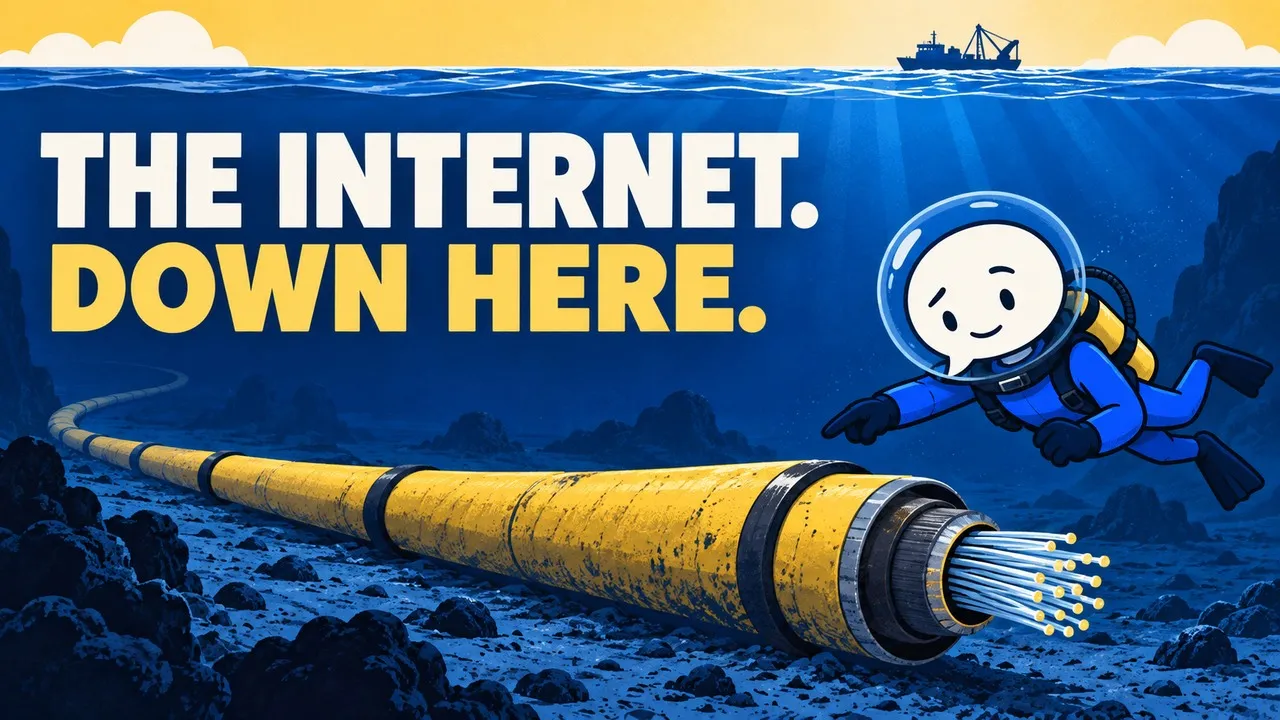
Networks depend on equipment and connections: routers, radio links, copper wires and fibre-optic cables. Submarine cables provide physical links across oceans. Signals travel through the glass fibres as light, joining networks on different shores.

Follow the connections
The useful shift is to stop imagining the internet as a place in the sky. It is a collection of connected networks. Your device sits at one edge of that collection, and a website or another person sits at another.